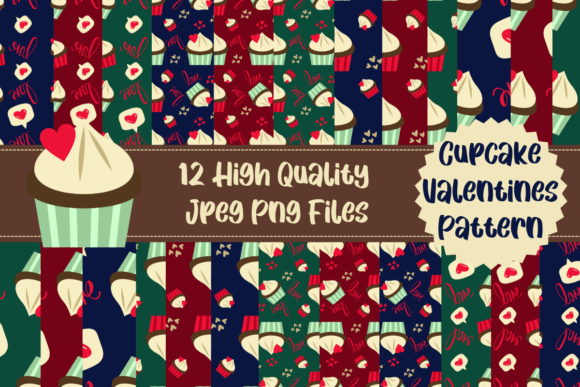
Cupcake Valentines Seamless Pattern
Whether you're designing a batch of handmade greeting cards, launching a small-batch confectionery brand, or refreshing your blog’s Valentine’s Day content, the right visual foundation makes all the difference. The Cupcake Valentines Seamless Pattern is more than just a collection of cute graphics—it’s a versatile, production-ready design resource built for real-world use. With its playful yet polished aesthetic—think pastel frosting swirls, delicate sprinkles, heart-topped cupcakes, and soft watercolor textures—it bridges the gap between whimsy and professionalism.
What sets this pattern apart isn’t just charm—it’s technical readiness. You receive 1 zipped file containing 12 unique seamless patterns, each delivered in both JPG and PNG formats at 300 dpi. That resolution means crisp printing on physical products like invitations, bottle caps, magnets, and even fabric-based items such as tote bags or aprons. The PNG files include transparent backgrounds—essential for layering onto photos, logos, or textured surfaces without visible edges or white halos.
Common Missteps—and How to Avoid Them
Many creators jump into using seamless patterns without checking compatibility or context—and that leads to avoidable hiccups. Here’s what often goes wrong—and how to sidestep it.
Assuming “Seamless” Means “Plug-and-Play Everywhere”
Not all software handles seamless tiling the same way. Some design tools (like Canva or basic photo editors) don’t auto-repeat patterns across large canvases unless you manually duplicate and align them. Others—like Adobe Photoshop or Illustrator—support pattern swatches natively, but only if the file is imported correctly (e.g., as a pattern fill, not a raster image placed once).
Better approach: Before starting your project, test one pattern tile in your intended tool. In Photoshop, go to Edit > Define Pattern; in Illustrator, drag into the Swatches panel. If you’re using Procreate or Affinity Designer, verify whether tiling is supported—or plan to use a repeat plugin or script. This saves hours of manual alignment later.
Overlooking Scale and Context
A cupcake pattern that looks delightful on a 4×6” greeting card can overwhelm a smartphone case or get lost on a large website banner. One customer reported ordering this pack expecting to use it on T-shirts—only to realize their chosen pattern repeated too densely, making individual cupcakes indistinct at garment scale.
Better approach: Preview patterns at actual size before committing. For apparel: zoom out to see how the motif reads from 3–5 feet away. For digital use: simulate screen resolution (e.g., 750×1334 for iPhone). Most design apps let you adjust pattern scale non-destructively—so start big, then shrink until the rhythm feels balanced, not busy.
Misjudging File Type Needs
Some users download only the JPG versions—then struggle when trying to overlay the pattern onto a colored background or logo. Because JPGs have solid white (or colored) backgrounds, they don’t blend cleanly. Others grab PNGs but forget to preserve transparency when saving edits, accidentally flattening layers and losing flexibility.
Better approach: Use JPGs for print-only applications where background color is fixed (e.g., letterpress invitations with white stock). Reach for PNGs whenever you need clean overlays—like placing the pattern behind text on a website header or wrapping it around a custom nail art design. And always save edited versions with transparency intact (e.g., PNG-24 in Photoshop, not JPEG).
Skipping the DPI Check—Especially for Physical Products
While 300 dpi is standard for high-quality print, some users assume “digital download = automatically print-ready.” But if you’re sending files to a local print shop or online service like Printful or Vistaprint, they’ll often reject uploads under 200 dpi—or worse, accept them and produce blurry output.
Better approach: Confirm your final canvas size *before* applying the pattern. A 12×12” scrapbook paper design needs the full 300 dpi at that dimension—but a 2×2” magnet only requires 600×600 pixels at 300 dpi. Use image resizing tools (like Photopea or Photoshop’s Image Size dialog) to scale intelligently—not just stretch.
What to Verify Before You Download or Design
Before opening that zip file—or worse, before purchasing a similar pack elsewhere—take two minutes to check these practical details:
- Tile dimensions: Are the patterns square (e.g., 3000×3000 px)? Non-square tiles often cause misalignment during repeat.
- Color mode: RGB is ideal for digital use; CMYK is preferred for professional offset printing. This pack uses RGB—perfect for web, social, and most on-demand printers (which convert internally).
- Licensing scope: Does the license allow commercial use? This pack permits use on physical and digital goods you sell—including Etsy listings, Shopify stores, and client projects—no extra fees or attribution required.
- Transparency fidelity: Open a PNG in a viewer that shows transparency (like Firefox or Preview on Mac). Look for clean edges—no faint gray halos or leftover anti-aliasing fringes around cupcakes.
Real-World Uses That Shine
This isn’t just for greeting cards. Designers have used these patterns in surprisingly effective ways:
- A wedding planner layered a subtle cupcake pattern behind RSVP text on foil-stamped invitation suites—soft enough to read, rich enough to feel special.
- A small-batch candle maker printed the pattern onto kraft labels, then die-cut them into heart shapes for Valentine’s mini jars—creating cohesion across packaging and social media banners.
- An educator created printable classroom valentines with editable student names over a light pink cupcake tile—parents loved the consistency with the school’s “sweet learning” theme.
- A freelance graphic designer used one of the PNG patterns as a texture overlay in Figma, adjusting opacity to 12% for a gentle, tactile feel on a SaaS landing page hero section.
The strength of the Cupcake Valentines Seamless Pattern lies in its balance: joyful but not childish, detailed but not cluttered, nostalgic but not dated. It works because it was built for doing—not just displaying.
If you’re evaluating similar resources, ask yourself: Does it come with both JPG and PNG? Is resolution clearly stated—not just “high-res”? Are the tiles truly seamless (test by duplicating side-by-side in any editor)? And most importantly—does it serve your next project, not just your mood board?
When you open that zip file and drop the first pattern into your layout, you’ll notice something immediate: no gaps, no glitches, no guesswork. Just 12 reliable starting points—ready to support your creativity, not slow it down.