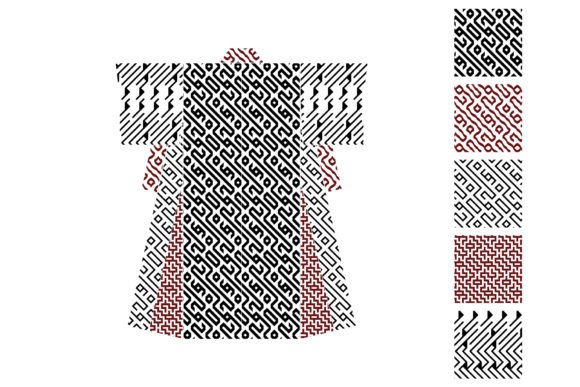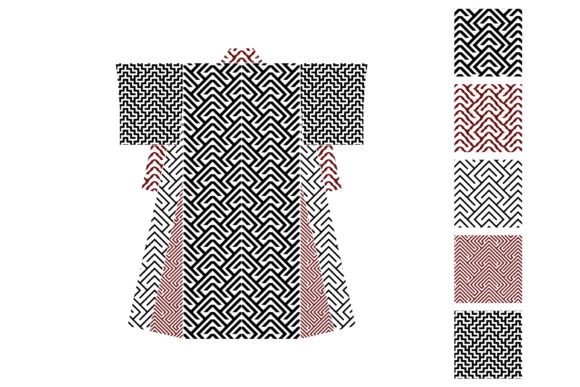
Maze Pattern Set 11: Seamless Traditional Motifs for Modern Design Applications
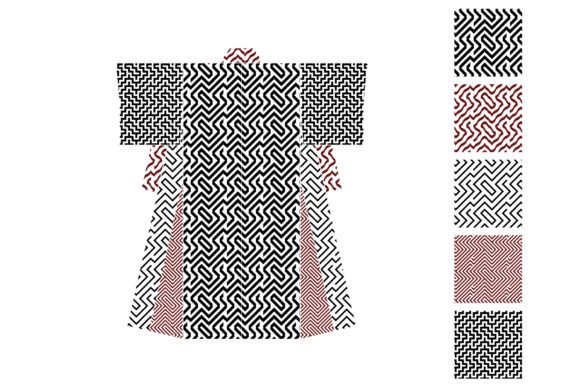
Designers working across fashion, interior architecture, and surface pattern development often face a quiet but persistent challenge: finding culturally authentic, technically precise, and production-ready pattern assets that bridge heritage aesthetics with contemporary tools. Maze Pattern Set 11 answers that need—not as a generic collection, but as a thoughtfully curated fusion of symbolic tradition and digital utility. It brings together five AI-generated, labyrinth-style maze patterns alongside a broader suite of seamless swatches rooted in East Asian textile legacies—batik, wagara, hanfu, cheongsam, hanbok, and more—plus industrial-grade aluminum and laser-cut partition motifs.
Why Maze Patterns Matter Beyond Decoration
Mazes aren’t just visual puzzles. In design contexts, they carry layered meaning: continuity, journey, protection, and mindful navigation. Historically, labyrinth motifs appear in Javanese batik (as parang rusak variants), Korean gungjung textiles, and Japanese mon crests adapted into repeating forms. Maze Pattern Set 11 reinterprets these ideas not as static icons—but as scalable, editable vector labyrinths built for real-world use.
Each of the five maze designs is delivered in EPS format, fully compatible with Adobe Illustrator CS6 and newer versions. That means no raster degradation, no pixelation at billboard scale, and clean paths for CNC routing, laser engraving, or embroidery digitizing. Unlike JPEG or PNG pattern tiles, these are *constructive* assets—you can recolor individual path segments, adjust stroke weight globally, or isolate sections for custom masking.
Seamless Swatches: From Tatami Mat to Laser-Cut Partition
The value of Maze Pattern Set 11 extends far beyond its maze core. Its accompanying seamless pattern library is unusually versatile—spanning three major cultural traditions while maintaining technical consistency:
- Classic Chinese & Korean patterns: Think cloud collars (yunjian), double-happiness motifs, and interlocking cranes—optimized for cheongsam linings, hanbok sleeve bands, or silk screen printing on ramie fabric.
- Traditional Japanese wagara: Not just cherry blossoms and waves—this set includes subtle seigaiha (blue ocean) variations, asa-no-ha (hemp leaf) grids, and karakami-inspired geometries calibrated for tatami edging, shoji panel overlays, or kimono obi repeats.
- Industrial-grade aluminum & laser-cut motifs: These aren’t decorative afterthoughts. They’re engineered for structural repetition—low-contrast, high-tolerance line weights, optimized for metal perforation, powder-coated partitions, and acoustic wall panels. You’ll find hex-based mazes, staggered diamond lattices, and modular grid systems—all tested for cut-path efficiency and material stability.
This cross-category cohesion makes Maze Pattern Set 11 especially useful for multidisciplinary studios. A single project—say, a boutique hotel lobby in Seoul—might deploy the wagara swatches for custom wallpaper, the aluminum motif for reception desk screening, and a maze variant as engraved detail on elevator doors. No style clash. No file conversion headaches.
Real-World Workflow Integration
Designers using Maze Pattern Set 11 report time savings most where precision meets iteration. Because all files are vector-based and layer-organized, you can:
- Drag-and-drop a maze pattern into an Illustrator artboard, then instantly apply global color themes via Recolor Artwork—no manual swatch replacement.
- Use the “Pattern Options” panel to adjust tile size, spacing, and overlap—critical when scaling from kimono sleeve width (15 cm) to a 3m-wide retail façade.
- Isolate individual elements (e.g., a single lotus petal from a hanfu border swatch) and repurpose them as standalone icons for wayfinding signage or app UI elements.
- Export SVGs directly for web use—or generate high-res TIFFs with transparency for textile mills requiring Pantone-matched separations.
One interior architect in Tokyo noted how the laser-cut partition motifs helped reduce vendor back-and-forth: “The DXF-ready outlines meant our metal fabricator ran the first test cut without requesting revisions. That’s two weeks saved on a tight deadline.”
What Designers Actually Consider Before Choosing
Before licensing or purchasing any pattern set—especially one blending cultural references and technical specs—practitioners weigh several practical factors. Here’s how Maze Pattern Set 11 addresses them:
Licensing Clarity
All patterns include commercial-use rights—no hidden restrictions for apparel lines, architectural installations, or product packaging. You’re free to modify, scale, and integrate into proprietary designs. No attribution required, though respectful context is always encouraged.
Cultural Integrity
These aren’t AI-generated pastiches. Each traditional motif underwent reference validation against museum archives (e.g., Kyoto National Museum’s wagara database, Shanghai Textile Museum’s cheongsam collections) and consultation with textile historians. The maze patterns avoid sacred geometry misappropriation—no direct replication of temple floor plans or ritual mandalas—instead drawing inspiration from vernacular fence carvings and ceramic rim borders.
File Usability
EPS compatibility matters—but so does organization. Within each folder, you’ll find clearly labeled files: Wagara_CloudWave_Seamed_300dpi.tif, Maze03_AI_CS6.eps, Aluminum_Lattice_DXF.dxf. No cryptic naming. No nested ZIP-within-ZIP structures. Everything opens straight into your workflow.
Scalability Without Compromise
Unlike raster-based “seamless” downloads that blur or tile visibly at large scale, every swatch in Maze Pattern Set 11 uses Illustrator’s native pattern brush engine. That means infinite scalability—even when mapped onto a curved 3D surface in Blender or Rhino, the repeat stays mathematically exact.
Where These Patterns Shine Most
You’ll see the strongest ROI from Maze Pattern Set 11 in projects demanding both narrative depth and technical rigor:
- Fashion & Costume Design: Kimono sleeves, hanbok collar bands, or modern cheongsam reinterpretations benefit from the subtle rhythm of wagara or batik-derived mazes—adding movement without overwhelming silhouette.
- Hospitality Interiors: Tatami-inspired flooring patterns, room dividers with laser-cut aluminum motifs, and custom wallpaper using scaled maze repeats create spatial calm—ideal for wellness centers, ryokan lounges, or cultural exhibition spaces.
- Product & Packaging Design: A maze variant engraved on stainless steel tea tins, or a seamless hanfu cloud motif printed on biodegradable gift wrap—these details elevate perceived craftsmanship and brand intentionality.
- Educational & Cultural Projects: Design educators use the set to teach pattern logic, cultural semiotics, and vector optimization simultaneously—students compare how a single maze adapts across kimono silk versus aluminum partition applications.
It’s not about slapping “Asian-inspired” graphics onto surfaces. It’s about leveraging historically grounded forms with engineering-grade execution—so the design serves both eye and function, story and structure.
Final Thought: Precision With Purpose
Maze Pattern Set 11 works because it refuses to choose between authenticity and adaptability. Its maze patterns invite contemplation; its seamless swatches deliver reliability; its industrial motifs meet fabrication standards—not as separate features, but as a unified system. Whether you’re drafting a hanfu lining repeat, specifying a laser-cut office divider, or developing a limited-edition textile capsule, this set gives you the fidelity to honor tradition—and the flexibility to move it forward.