Maze Pattern Set 8: Where Heritage Motifs Meet Precision Digital Craftsmanship
Designers, product developers, and interior architects are increasingly navigating a dual imperative: honoring cultural authenticity while meeting the exacting demands of modern production—be it laser-cut aluminum partitions, seamless textile repeats for hanbok or cheongsam fabrication, or high-fidelity tatami surface treatments. Maze Pattern Set 8 emerges not as a standalone graphic asset, but as a strategic convergence point—bridging centuries-old visual languages with AI-powered vector precision and cross-industry application logic.
A Seamless Bridge Across Traditions and Technologies
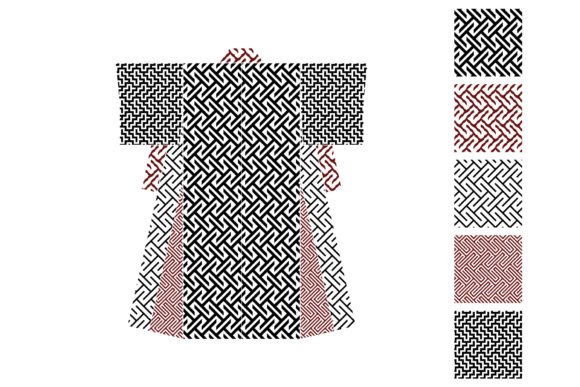
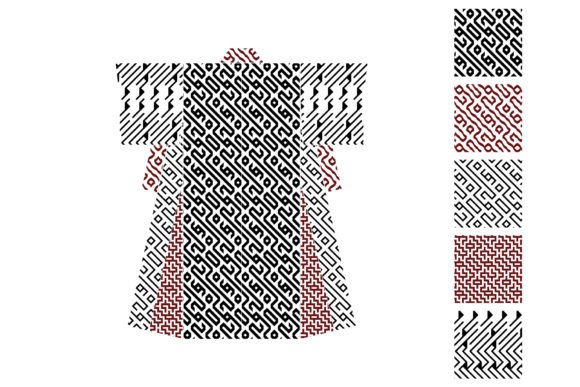
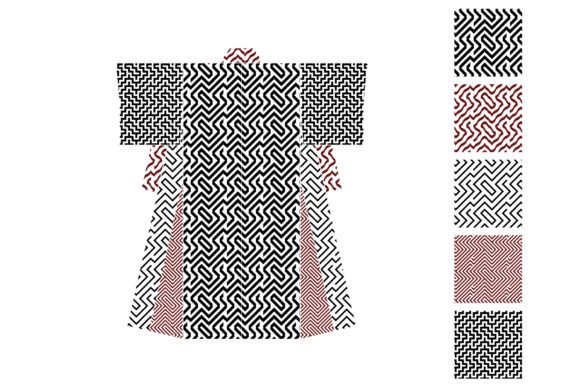
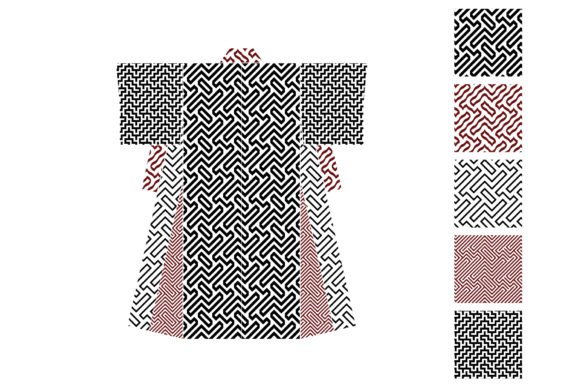
Maze Pattern Set 8 is a curated collection of five original labyrinth-style patterns, delivered in AI EPS format compatible with Adobe Illustrator CS6 and above. Unlike generic maze vectors, these designs are intentionally calibrated for functional versatility: each pattern maintains consistent stroke weight, scalable geometry, and repeat-ready alignment—critical for both screen-based visualization and physical output across diverse substrates.
What distinguishes this set is its contextual intelligence. The mazes aren’t abstract puzzles; they’re designed to resonate with the compositional grammar of classic Chinese, Korean, and Japanese decorative traditions. Think of the rhythmic continuity found in wagara motifs used on kimono silks, the balanced asymmetry of Hanfu border bands, or the meditative repetition in Korean munjang (patterned floor cloths). These aren’t pastiches—they’re structural reinterpretations grounded in proportion, flow, and symbolic resonance.
Why This Timing? Converging Trends Driving Demand
Three interlocking shifts make Maze Pattern Set 8 especially relevant now:
- The Resurgence of Tactile-First Design: As digital interfaces saturate daily life, consumers and brands alike seek material authenticity. Interior spaces—especially hospitality, retail, and wellness environments—are prioritizing texture, depth, and narrative. Laser-cut aluminum partitions featuring labyrinth motifs offer visual intrigue *and* acoustic modulation. Tatami mats with subtle wagara-inflected maze repeats reinforce cultural grounding without overt literalism. This isn’t nostalgia—it’s material storytelling with functional integrity.
- The Rise of Cross-Cultural Product Development: Global fashion labels, home goods startups, and even architectural firms no longer treat East Asian aesthetics as “inspiration” to be extracted. Instead, they engage in respectful, technically rigorous adaptation. A hanbok designer sourcing seamless swatches for silk jacquard weaving needs precise registration points, consistent scale across fabric widths, and compatibility with digital loom software. Maze Pattern Set 8 delivers that baseline fidelity—enabling designers to focus on cultural nuance and fabrication rather than vector cleanup or repeat misalignment.
- The Professionalization of Creative Asset Management: Freelancers and small studios can no longer afford fragmented workflows. A single pattern must serve multiple outputs: a 300 dpi print file for textile sampling, an SVG export for CNC routing parameters, and a layered AI file for client presentation with editable color swatches. Because Maze Pattern Set 8 ships in native Illustrator EPS—fully editable, non-rasterized, and resolution-independent—it integrates directly into existing pipelines without conversion loss or licensing friction.
Practical Applications: Beyond the Obvious
Consider how Maze Pattern Set 8 operates in real-world scenarios:
- Interior Architecture: A Tokyo-based firm uses one maze variant as the basis for a perforated aluminum room divider in a boutique hotel lobby. The labyrinth’s continuous line translates seamlessly into laser-cut paths—minimizing material waste while creating dynamic shadow play across daylight hours. The same vector file is scaled down 90% for engraved brass inlay on reception desk edges, maintaining proportional harmony.
- Fashion & Textiles: A Seoul-based hanbok atelier licenses the set to develop limited-edition obi-inspired sashes. They layer the maze over traditional kkachi horangi (magpie-tiger) motifs—not as overlay, but as a structural grid that guides placement and scale. The result feels both contemporary and deeply rooted, appealing to Gen Z clients seeking identity through intentional heritage.
- Product Design: A Shanghai ceramics studio adapts a maze motif into a slip-cast mold for porcelain tea sets. The pattern’s uniform line thickness ensures even glaze pooling during firing, while its closed-loop structure prevents weak points in the ceramic wall. Here, the maze isn’t decoration—it’s an engineering constraint made expressive.
Technical Rigor Meets Cultural Literacy
This isn’t about slapping “Asian-inspired” graphics onto surfaces. It’s about understanding why certain rhythms work across contexts. Traditional Japanese wagara relies on komon (small-repeat) discipline—where every millimeter matters for visual cohesion at scale. Korean dancheong painting uses geometric frameworks to organize symbolic elements. Chinese cloud-collar motifs (yunjian) follow radial symmetry that implies cosmic order. Maze Pattern Set 8 internalizes those principles: its labyrinths avoid dead ends, maintain consistent negative-to-positive space ratios, and resolve cleanly at tile boundaries—ensuring that whether printed on silk or etched into aluminum, the pattern reads as intentional, not accidental.
Moreover, the set anticipates emerging production realities. As generative design tools mature, designers increasingly use base patterns as seed inputs for AI-assisted variation. Because Maze Pattern Set 8 is built with clean anchor points, logical path directionality, and parametric-friendly construction, it serves as a robust foundation—not just for static use, but for algorithmic extension. A marketer building a campaign around “pathfinding” or “journey narratives” could generate dozens of brand-aligned variants from a single EPS file, all retaining core structural DNA.
Shifting Expectations: From Decoration to Dialogue
Today’s audiences don’t just consume patterns—they interpret them. A maze on a cheongsam isn’t merely ornamental; it invites reflection on personal journey, resilience, or choice. When used in a healthcare waiting area via laser-cut wall panels, it subtly supports cognitive engagement—a gentle, non-clinical intervention. Professionals selecting assets like Maze Pattern Set 8 are therefore making ethical and experiential choices, not just aesthetic ones.
This reflects a broader industry evolution: away from “design as embellishment” toward “design as infrastructure.” Patterns now carry functional weight—guiding wayfinding, modulating light, influencing acoustics, signaling cultural values, or enabling sustainable manufacturing. Maze Pattern Set 8 meets that expectation by being simultaneously precise and poetic, technical and evocative, globally deployable yet locally resonant.
Looking Ahead: Integration, Not Isolation
The future of pattern libraries lies not in larger volumes, but in deeper interoperability. Maze Pattern Set 8 signals a maturing standard—one where cultural specificity, production readiness, and creative flexibility coexist without compromise. As aluminum becomes a primary medium for biophilic architecture, as digital textile printing enables micro-batch hanfu production, and as global brands deepen their commitment to culturally intelligent design, assets like these move from “nice to have” to foundational infrastructure.
For entrepreneurs launching heritage-forward lifestyle brands, for freelancers pitching to international clients, for marketers building campaigns with layered meaning—Maze Pattern Set 8 offers more than files. It offers fluency: a shared language between tradition and technology, craft and code, symbolism and scalability. That fluency isn’t inherited—it’s engineered. And it starts with knowing which lines to draw, where to begin, and how to find your way forward—without ever losing sight of the destination.